

Paris has always been rather good at making people fall in love with it.
There are the obvious things: beautiful architecture, little cafés spilling onto pavements, long lunches, the Seine, museums, bakeries that make you question every previous decision you’ve ever made about croissants.
But Paris has another trick up its sleeve.
It turns out it’s a pretty brilliant place to work, too.
According to a 2026 workation ranking highlighted by Condé Nast Traveller, Paris has been named the world’s top workation destination, beating cities including Bangkok, London, Hong Kong and Guangzhou.
And before you picture yourself hunched over a laptop in a hotel room while Paris carries on outside without you, that’s not quite the idea.
A workation is about finding that sweet spot between getting your work done and actually enjoying where you are. And Paris appears to strike that balance rather well.
So, what exactly makes the French capital such a good choice for a workation in 2026?
Why did Paris rank number one?

The ranking looked at several factors that can make or break a workation, including summer temperatures, air quality, elevation, access to water and nature, hotel prices, walkability, broadband speed and the availability of co-working spaces (e.g. WeWork locations).
Paris didn’t necessarily come out on top in every single category. That’s not really the point.
Instead, it performed strongly across a combination of factors that matter when your holiday destination also happens to be your temporary office.
And that combination is what makes Paris interesting.
Because let’s be honest: a city can have fantastic Wi-Fi, but if leaving your apartment involves a 45-minute commute and three changes on public transport, the romance starts to wear off fairly quickly.
Paris is remarkably easy to explore on foot
One of Paris’s biggest strengths is its walkability.
The city received a 9.7 walkability score in the ranking, making getting around on foot one of its standout advantages.
And for a workation, this matters more than you might think.
When you’re travelling purely for leisure, spending an hour getting across a city might be part of the adventure. When you’re trying to squeeze sightseeing around meetings at 10 am and 3 pm, it’s considerably less charming.
Paris gives you the opportunity to make the journey itself part of your day.
You can walk to a café in the morning, wander to lunch, explore a different neighbourhood after finishing work or take a leisurely stroll along the Seine when your laptop finally gets shut.
There’s something wonderfully simple about it.
Instead of commuting from your accommodation to an office and then from the office to somewhere interesting, you can quite literally step outside and find yourself surrounded by things worth seeing.
The Wi-Fi is no joke
A beautiful city is all very well, but your boss may be less impressed by the Eiffel Tower than you are if your video call keeps freezing.
Fortunately, Paris performs well on the connectivity front.
The ranking recorded an average broadband speed of 240.67 Mbps for Paris, giving remote workers a solid digital foundation.
That matters if your work involves video calls, cloud-based systems, large files or simply the ability to open 17 browser tabs without immediately questioning your life choices.
Reliable internet means you can work from your accommodation or seek out a dedicated workspace without feeling as though you’re gambling your career on the strength of the café’s Wi-Fi.
And that’s an important part of a successful workation: your work environment needs to be dependable enough that you can actually relax once the working day ends.
The weather helps, too
Another factor in Paris’s favour is its summer climate.
The ranking considered summer temperatures as part of its assessment, and Paris performed well compared with some of the hotter destinations on the list.
This might sound like a small detail, but climate can have a surprisingly big effect on your workation.
There’s a difference between finishing a video meeting and heading out for an evening walk in comfortable weather, and finishing that same meeting while feeling as though you’ve been slow-roasted in your own accommodation.
Paris offers the possibility of enjoying the outdoors before or after work without necessarily having to battle extreme summer heat.
And that makes a difference when you’re trying to build a pleasant daily routine.
The real attraction? Work doesn’t have to take over your trip
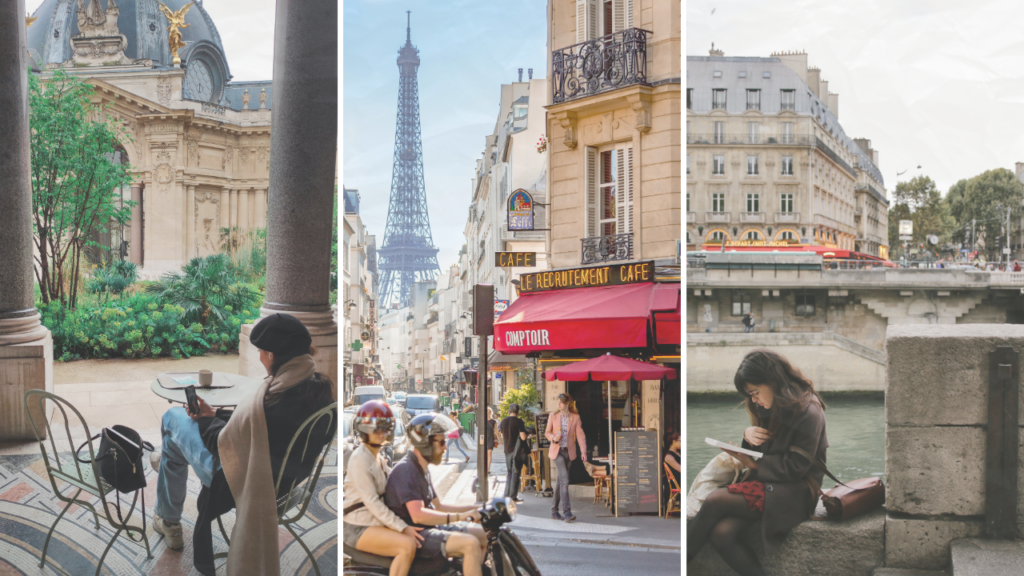
This is perhaps the biggest reason Paris works so well as a workation destination.
A good workation isn’t simply a holiday where you’ve brought your laptop along.
It’s about creating a routine where work and travel can exist alongside one another.
Imagine starting the day with coffee and a short walk through your neighbourhood. You spend the morning working, grab lunch somewhere nearby, return to your laptop for the afternoon and then, once you’re finished, you’re free to explore.
You might walk along the Seine.
Visit a gallery.
Find a tiny restaurant you’ve never heard of.
Sit outside with a glass of something cold.
Or simply wander with absolutely no destination in mind, which, in Paris, is a perfectly respectable way to spend an evening.
The point is that you’re not waiting for the weekend to experience the destination.
You’re experiencing it throughout the week.
Paris gives you plenty of places to work
One of the things that makes a workation easier is having options.
Some days, you might want the comfort and quiet of your accommodation. Other days, getting out of the room is essential for both productivity and your sanity.
Paris offers a mixture of coworking spaces, cafés, hotels and other places where remote workers can set up for a few hours.
The 2026 ranking also considered the availability of WeWork locations, recognising that access to dedicated workspace can be an important part of a city’s workation appeal.
And having options means you don’t have to follow the same routine every day.
Monday could be a focused coworking day.
Tuesday might involve working from your accommodation.
Wednesday could be a café-and-laptop situation.
Thursday? Well, Thursday could probably involve a very serious meeting with a pain au chocolat.
For research purposes, obviously.
Which areas of Paris could be good for a workation?

Paris is made up of neighbourhoods that can feel surprisingly different from one another, so where you stay can have a big impact on your experience.
Le Marais
If you want to be close to restaurants, shops, galleries and plenty of Parisian atmosphere, Le Marais is an obvious choice.
It’s lively, central and particularly appealing if you want to step outside after work and immediately feel like you’ve arrived somewhere.
Saint-Germain-des-Prés
For a more classic Paris experience, Saint-Germain-des-Prés brings the famous café culture, elegant streets and central location.
It can be a particularly appealing choice for anyone who likes the idea of doing a little work before settling into a long, leisurely evening.
Canal Saint-Martin
If you’d prefer something a little more relaxed, Canal Saint-Martin offers a different pace.
The area has a more local feel and gives you somewhere pleasant to escape to when your laptop has started looking suspiciously judgmental.
Montmartre
Montmartre brings character, views and plenty of that instantly recognisable Paris atmosphere.
It can be a good fit for travellers who want their surroundings to feel distinctly Parisian rather than simply convenient.
Some days, a change of scenery is all you need to get those creative juices flowing. Take a look at some of the best coworking spaces in Paris and find your ideal spot to work.
Is Paris expensive for a workation?
Now for the slightly less romantic bit.
Paris isn’t exactly famous for being a budget destination.
In fact, the cost of accommodation is one area where some competing workation destinations have a significant advantage. The 2026 ranking, for example, highlights Bangkok’s much lower median hotel price compared with Paris.
So if your number-one priority is finding the cheapest possible place to work remotely, Paris probably isn’t going to win that particular competition.
But that’s also why it’s worth looking at the ranking as a whole.
Paris’s number-one position isn’t simply about price.
It’s about the combination of connectivity, walkability, climate, access to amenities and the overall experience of living in the city while working.
And there are still ways to make a Paris workation more manageable financially.
Staying slightly outside the most expensive central areas, choosing accommodation with kitchen facilities, using public transport and staying for longer rather than making several short trips can all help.
The trick is to think less like a tourist trying to see everything in three days and more like someone temporarily living in Paris.
What could a day on a Paris workation look like?
Here’s where the idea starts to become rather appealing.
8:00am: Coffee and a morning walk.
9:00am: Start work.
12:30pm: Lunch somewhere nearby.
1:30pm: Back to work.
5:00pm: Close the laptop.
5:30pm: Walk along the Seine, explore a neighbourhood or visit a museum.
8:00pm: Dinner.
10:00pm: Wonder why you don’t live here permanently.
Repeat.
Of course, real life isn’t quite that neat. There will be unexpected work or meetings. There may be days when the only sightseeing you manage is the inside of your accommodation.
But that’s precisely why Paris works as a workation concept.
You don’t need every day to feel like a holiday.
You just need enough of the destination to make the working days feel different.
Paris isn’t necessarily the cheapest, and that’s okay!
It’s tempting to assume that the best workation destination must be the cheapest one.
But that’s not necessarily true.
If saving money were the only consideration, the ranking would look very different.
Paris’s appeal is more about quality of experience.
You’re getting a city where you can work with reliable connectivity, move around relatively easily without a car, enjoy a comfortable climate and spend your free time surrounded by an extraordinary amount of culture, food and history.
That’s a pretty compelling combination.
The best workation destination isn’t necessarily the place where your accommodation costs the least.
It’s the place where you can close your laptop at the end of the day and genuinely feel like you’re somewhere worth being.
Who is a Paris workation best for?
Paris could be particularly appealing for:
- Remote employees who can work from abroad
- Freelancers and consultants
- Entrepreneurs
- Digital nomads
- Creatives looking for a change of scenery
- Couples who want to combine work and travel
- Anyone who wants a longer stay rather than a rushed city break
It may be less suitable if you’re working with a very tight budget or if you’re looking for a tropical, beach-based workation.
But if your idea of work-life balance involves architecture, cafés, culture, excellent food and the occasional unnecessary purchase from a charming little shop, Paris has a strong argument.
How to make your Paris workation actually work
Before booking your trip, it’s worth thinking about the practical side.
Make sure your accommodation has reliable Wi-Fi and, ideally, a comfortable place to work.
Have a backup workspace in mind in case you need somewhere quieter for an important meeting.
Check your employer’s policies if you’re employed remotely, particularly around working from another country.
Think about your working hours and whether you’ll need to be online at specific times.
And most importantly, choose your neighbourhood carefully.
You don’t want to spend your entire workation travelling across Paris just to get to your workspace.
The beauty of a workation is that your working day and your travel experience should complement one another, not compete for your time.
So, why is Paris one of the best workation destinations in 2026?
Paris didn’t become the top workation destination simply because it’s beautiful.
Its position at the top of the 2026 ranking comes from a combination of practical and lifestyle factors.
It scored highly for walkability, with a 9.7 score, and offered strong broadband speeds of 240.67 Mbps. Its summer climate also compared favourably with some other major cities included in the ranking.
But the numbers only tell part of the story.
The real advantage is what happens when those factors come together.
You can work efficiently.
You can get around without spending your life commuting.
You can step away from your screen and immediately have a city full of things to experience.
And perhaps most importantly, Paris makes it surprisingly easy to remember that you’re not just there to work.
You’re there to live a little differently for a while.
So, is Paris the best workation destination in the world?
That’s ultimately subjective.
But if you’re looking for a city where fast internet, walkable streets, culture, food and an enviable after-work lifestyle all come together, Paris has made a very convincing case for itself in 2026!